
The Kiekens Venturi is our top of the line Desuperheater, known all over the world as the most reliable Desuperheaters on the market. Therefore, the Kiekens Venturi is frequently used in the oil and gas industry, where the highest safety standards are applicable.
Steam
Desuperheaters as solution for steam applications
Desuperheaters are a critical component used in the management of steam from power generation sources to industrial uses of steam. Kiekens delivers Desuperheaters for all kind of steam applications that experience wide variations in load.
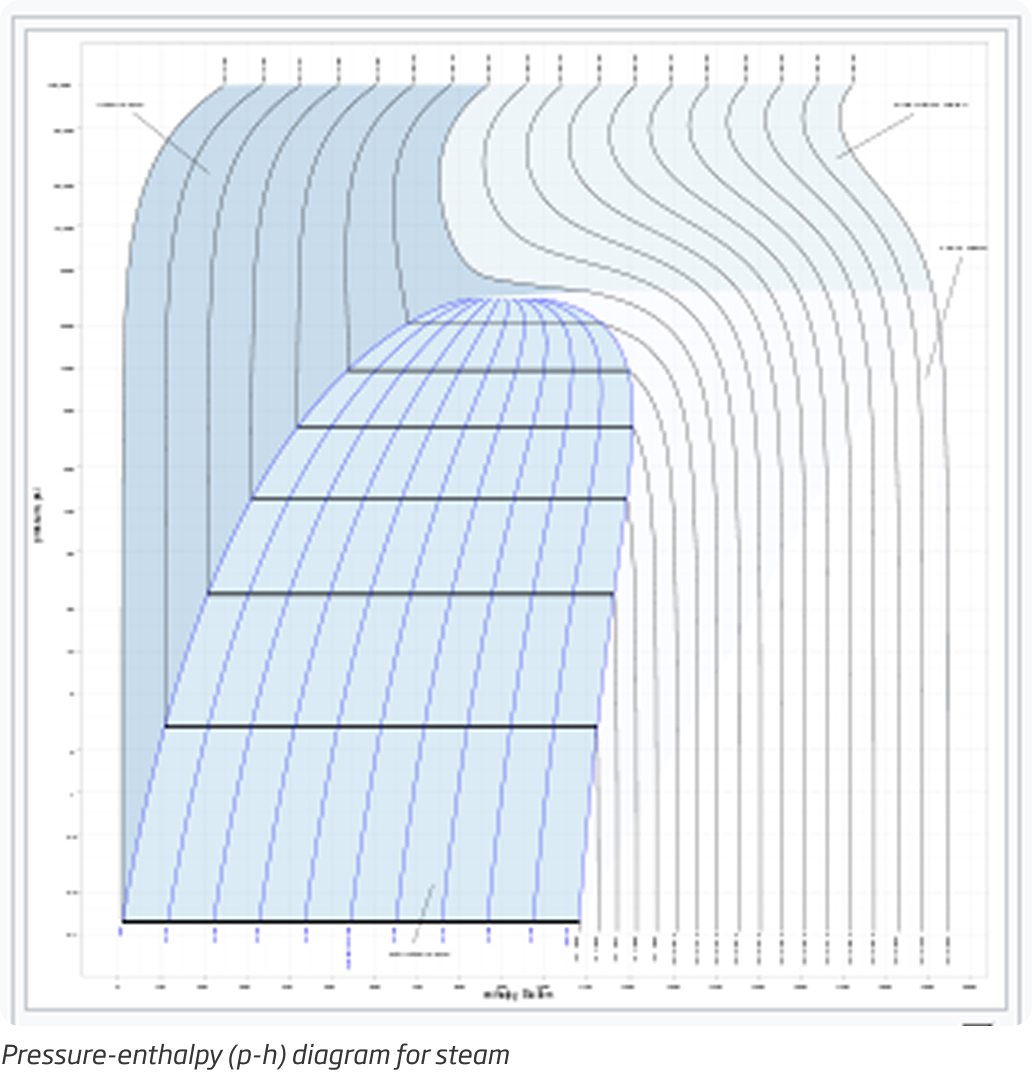
Pressure-enthalpy (p-h) diagram for steam
What is steam?
Steam is water in the gas phase, which is formed when water boils. Steam is invisible; however, “steam” often refers to wet steam, the visible mist or aerosol of water droplets that is formed when water vapour condenses. At lower pressures, such as in the upper atmosphere or at the top of high mountains, water boils at a lower temperature than the nominal 100 °C (212 °F) at atmospheric pressure. When heated further, for instance in a boiler superheater, wet steam becomes superheated steam.
How does a desuperheater work with steam?
The desuperheater working principle is to control and condition the temperature of superheated steam, which is crucial for many industrial processes. The definition of a desuperheater is a piece of equipment that atomizes and evaporates the cooling supply liquid, usually water, into droplets in the smallest size possible. The aim of this process is to reduce the temperature of the incoming gas, usually steam, within the shortest possible distance and time to the required and controlled level. This is ultimately also the desuperheater function.
What is superheated steam?
Superheated steam is steam that is heated above the previously mentioned boiling temperature of 100 °C (212 °F) at atmospheric pressure. This process involves a few different steps. When additional heat content is added to boiling water in liquid condition, the heat content (enthalpy) of the water further increases. The temperature of the water, however, maintains a constant value until all liquid has been evaporated to a gaseous state. At this point, a condition of so-called saturated steam is reached. When additional heat content is added to saturated steam, a condition of superheated steam is obtained. Superheated steam is also known as “dry” steam, as it contains no water droplets. It does contain, however, a lot of energy. The stored energy in dry steam makes it highly efficient to transport it to a point where the energy is required.
What is desuperheated steam?
When a Desuperheater is deployed to reduce the pressure of superheated steam that is supplied around a turbine or another power engine, this usually called ‘turbine bypass desuperheating’. The letdown (=reduced) steam is still strongly superheated, and although it could have reached the required pressure level at the outlet of the steam-reducing valve, it is usually still unsuitable for use owing to its temperature. In the steam turbine back pressure system to which the steam is fed, the basic requirement is to maintain the pressure and the temperature of this back pressure steam at a constant level, undependable of the load of the steam turbine.
What are the advantages of desuperheated steam?
Desuperheated steam, with its precise temperature, improves the quality of industrial products or processes, protects downstream equipment from heat related damage and can reduce unscheduled downtime of the production line or improve the efficiency of the downstream heat exchanger. Furthermore, the precisely controlled temperature allows you to start your chemical processes more efficiently.
In a back pressure turbine the desuperheated steam temperature is a function of steam load to the turbine. When the steam temperature gets too high, usually at low turbine loads, desuperheated steam can be used to assure proper operation of the downstream installed process equipment.
Frequently, this downstream equipment consists of heat exchangers that are preferably fed with steam at a temperature as close as possible to the saturation temperature.
What is the true desuperheated steam temperature?
It is advised, by temperature control suppliers, to always measure “dry” steam. This means that all injected cooling water should be evaporated in the desuperheated steam. If the specified desuperheated steam must be at saturation temperature, it is advised to keep temperature around 5 °C above saturation temperature to prevent water droplets or wet steam hitting the temperature controller. If water droplets or not completely mixed wet steam hit the wall of a temperature controller, it will not give a true reading. The system may start to get unstable, as the temperature is not rightly controlled. The distance from the water injection point to the temperature sensing device is critical. Steam and water should be properly mixed and evaporated. The shorter the distance, the more efficient the desuperheater.
When is steam pressure and temperature control required?
Superheated steam coming out of the power boiler is generated at high pressure and temperature, and transported as thermal energy for a lot of systems in the plant. Depending on plant demand in refineries, (petro) chemical plants and power plants, these high pressures and temperatures must be reduced to desuperheated steam in order to assure stable, accurate and safe operation.
The Kiekens desuperheaters can be combined with a separate pressure control valve (PCV) and (separate) temperature control valve (TCV) to reduce both the pressure and temperature in a so-called pressure reducing desuperheating system (PRDS). Desuperheater process calculations can be made to select the best suitable desuperheater and desuperheater valves in the PRDS.
Following examples of pressures reducing systems can be found in the plant:
- EHP (90-120 bar) to HP (40-60 bar) level;
- HP (40-60 bar) to MP (15-25 bar) level;
- MP (15-25 bar) to LP (4-8 bar) level;
- LP (4-8 bar) to LLP (1-3 bar) level;
- EHP (90-120 bar) to MP (15-25 bar) level;
- HP (40-60 bar) to LP (4-8 bar) level.
Pressure-enthalpy (p-h) diagram for steam
How do you select a desuperheater ?
When selecting a desuperheater it must be taken into account that this is not a standalone device. It is an important part of a system, and as such it has to be designed and sized in relation to the other system components and system parameters. Even the best desuperheater will not or insufficiently perform without correct sized control valves, the correct sensing- and control elements, a correct sizing of the connecting steam lines, sufficient straight pipe length up- and downstream of the unit, and eventual precautions against excessive noise.
How can Kiekens be of service?
Based on your specifications, Kiekens-DSH can perform all necessary calculations described above and supply a complete pressure reducing desuperheating system.
Share your specifications with us and request your quote.
Got a question?
Please let us know and we will get in contact with you.

Frequently Asked Questions (FAQ)
The Kiekens Venturi is our top of the line Desuperheater, known all over the world as the most reliable Desuperheaters on the market. Therefore, the Kiekens Venturi is frequently used in the oil and gas industry, where the highest safety standards are applicable.
The Kiekens Venturi is our top of the line Desuperheater, known all over the world as the most reliable Desuperheaters on the market. Therefore, the Kiekens Venturi is frequently used in the oil and gas industry, where the highest safety standards are applicable.